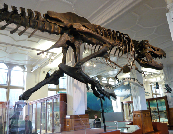






Palaeogravity calculations based on
weight and mass estimates of four
Tyrannosaurus rex specimens
by
Stephen W. Hurrell
weight and mass estimates of four
Tyrannosaurus rex specimens
by
Stephen W. Hurrell
Abstract
There is great interest in calculating accurate values for Earth’s palaeogravity. One fundamental technique to quantify palaeogravity is to compute weight against mass estimates of ancient animals. This technique is applied to four specimens of Tyrannosaurus rex, representing some of the most complete theropod dinosaur skeletons known. For the Tyrannosaurus rex specimens "Carnegie" CMNH 9380, “Wankel rex” MOR 555, "Stan" BHI 3033 and "Sue" FMNH PR 2081, the results indicate that a palaeogravity of 0.67g, 0.66g, 0.61g, and 0.64g ± 20% respectively are reliable estimates for 67 Ma.
Key Words: Palaeogravity, Tyrannosaurus rex
First published: 22 March 2019
Free pdf Rg A Ze Google Scholar
Suggested Citing Format
Hurrell, S.W. (2019). Palaeogravity calculations based on weight and mass estimates of four Tyrannosaurus rex specimens.
http://dinox.org/hurrell2019a
http://dinox.org/hurrell2019a
Page updated 13 Apr 2026
Wayback
Wayback
Comments
From Facebook - Bill Erickson - Great job Stephen! Have you sought or gotten feedback from any of the paleontologists you cite, e.g. Paul?
Palaeogravity Laboratory - No to both. It's all been very quiet even though they have been reading them (according to ResearchGate for example). That's probably as we might expect. If they agree they might look a fool, if they disagree they might also look a fool. The safest action for any palaeontologist is to say nothing for now.
Bill Erickson - You might consider submitting your paper to a peer reviewed journal, such as "Paleobiology" or the "Journal of Vertebrate Paleontology." Although I doubt they would publish it, that would at least force the reviewers to state their objections publicly.
Bill Erickson - I suspect that rather than disputing the carefully calculated mass estimates (based on body volume and density) or the carefully calculated weight estimates (based on bone dimensions), the reviewers will instead dismiss your reasoning, which points out the obvious conflict between the two carefully calculated data sets, and call you a fool for arguing in favor of the obvious albeit unacceptable unorthodox solution that surface g was lower 67 Ma than it is today




Share this page